Tell us about the job
Takes about a minute. No obligation.
A contractor quoting a boiler installation here has to size the unit for what the burner and heat exchanger will actually carry. Homes in Calaveras County, CA run heat about eight months a year, from October through May. Cycling that long, season after season, accelerates wear on the ignition system and the heat exchanger in ways a marginally undersized unit makes worse. Poor installation hides itself briefly in a short season; here, the burner runs too long and too often for a bad fit to stay quiet. The contractor's load calculation is not a formality in this county.
Ductwork laid in for a previous heating system shapes what a boiler installation can realistically do. Half the homes in Calaveras County, California were built in 1986 or earlier (2020-2024 ACS 5-year). That puts a contractor in houses where the distribution piping and existing runs reflect the demands of equipment long since removed, and where fitting a new boiler means checking whether those runs can carry what the replacement unit produces. The electrical service matters too, but it is the existing distribution layout that sets the scope and the price.
What Gets Installed With a New Boiler
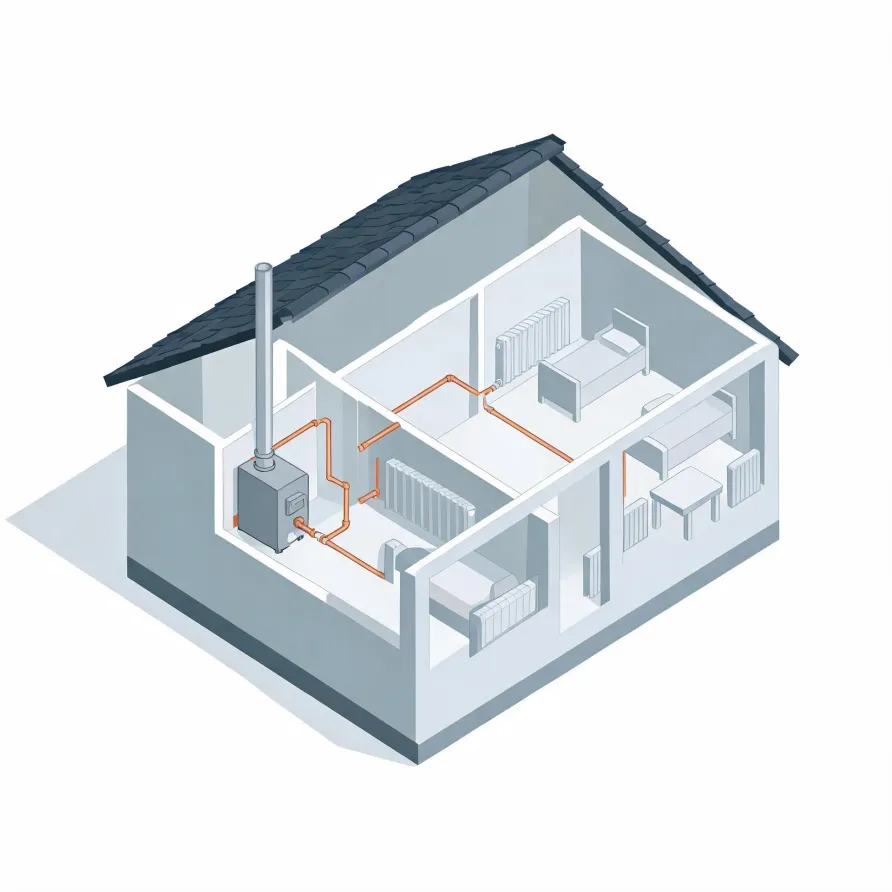
The boiler itself sits in a utility room, basement, or mechanical closet and is the unit a contractor mounts and connects first. From there, a network of pipes runs through the walls and floors, carrying heated water to radiators or radiant floor loops positioned throughout the living spaces.
Each radiator or floor loop has a valve that a contractor sets to control flow to that zone. The expansion tank, typically wall- or ceiling-mounted near the boiler, absorbs pressure changes in the system, and the circulator pump moves water through the whole circuit.
The drawing shows a representative layout, and a licensed contractor determines exactly which components and configurations apply to your home.
Get matched in Calaveras CountyCalaveras County by the Numbers
300 severe weather events were recorded in Calaveras County, California between 2015 and 2024.
NOAA National Centers for Environmental Information, Storm Events Database, bulk CSV export, events 2015-01-01 through 2024-12-31.Half the homes in Calaveras County, California were built in 1986 or earlier (2020-2024 ACS 5-year).
U.S. Census Bureau, 2020-2024 American Community Survey 5-Year EstimatesCalaveras County, California holds 27,683 housing units (2020-2024 ACS 5-year).
U.S. Census Bureau, 2020-2024 American Community Survey 5-Year EstimatesOwners occupy 84.0% of the occupied homes in Calaveras County, California (2020-2024 ACS 5-year).
U.S. Census Bureau, 2020-2024 American Community Survey 5-Year EstimatesCodes & Standards Governing Boiler Installation in Calaveras County, California1 sourced rules and standards
Licensing and Legal Requirements in Calaveras County, California
California requires a state contractor license: it is a misdemeanour to engage in the business of, or act in the capacity of, a contractor in California without one, unless the work is exempt.
Severe Weather Events in Calaveras County
Boiler systems work harder when outdoor conditions push to extremes, and the stress those conditions put on equipment is not abstract. How often that happens here shapes what a boiler in Calaveras County is asked to do and how well it needs to be installed to handle it.
300 severe weather events, 2015–2024. Source: NOAA National Centers for Environmental Information, Storm Events Database.