Tell us about the job
Takes about a minute. No obligation.
Sizing a boiler for this house is not a guess you refine later. Homes in San Francisco County, CA run heat about seven months a year, from November through May. Burner cycles and heat exchanger stress add up across those months, and a unit that is even slightly undersized runs harder and hotter than it should through every one of them. A contractor doing the load calculation here has to account for that cumulative demand before settling on output capacity, flue sizing, and expansion tank spec. Get those wrong and the parts that fail first are the ones that earned it.
Piping and distribution runs in much of this county's housing were sized and routed for equipment that has long since been replaced, and what a contractor finds behind the walls decides more about a boiler installation than the unit selected ever will. Half the homes in San Francisco County, California were built in 1946 or earlier (2020-2024 ACS 5-year). That depth of age means the original heat distribution layout was set before modern condensing boilers existed as an option, and the routing, the pipe diameters, and the near-boiler connections a contractor inherits reflect that. A new boiler may be specified correctly and still require substantial rework of what feeds it before the job is done.
What Gets Installed With a New Boiler
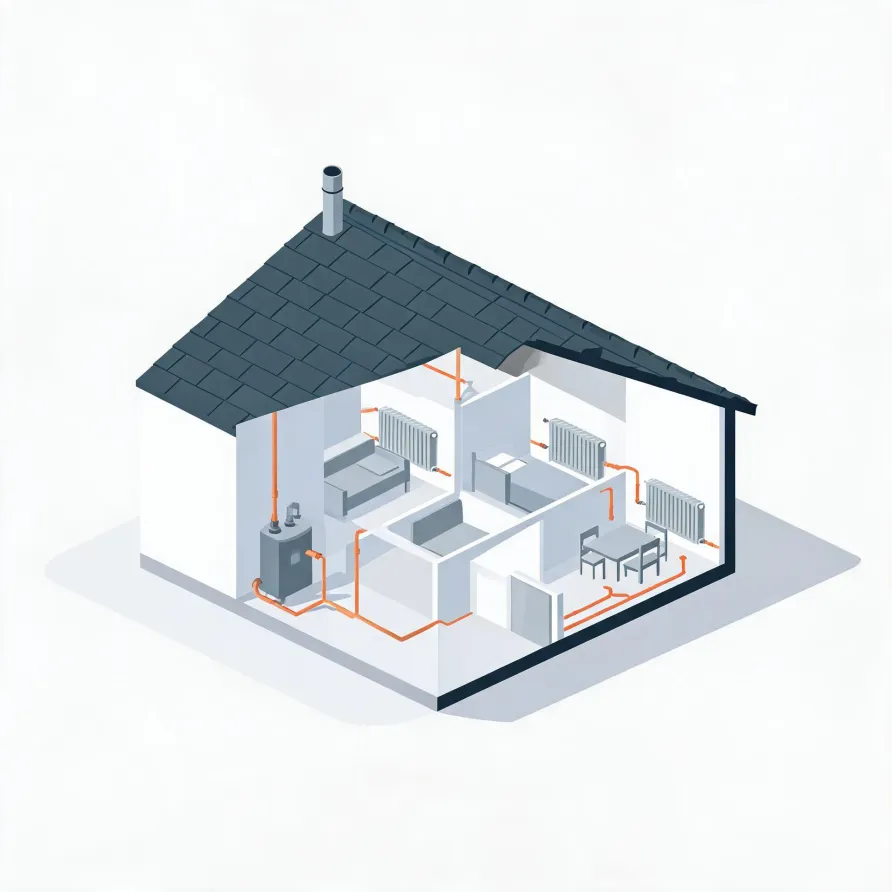
The boiler itself sits in a mechanical room, basement, or utility closet and is the unit that heats water for the whole system. From there, a network of pipes carries that heated water to radiators or radiant floor loops in each room, which release the warmth where the household needs it.
A circulation pump moves water through those pipes continuously, and an expansion tank mounted nearby absorbs pressure changes as the water heats and cools. The thermostat, placed on a wall in a main living area, is the control point that tells the boiler when to fire and when to rest.
The drawing shows a typical layout, and a licensed contractor determines which components and configurations apply to your specific home.
Get matched in San Francisco CountySan Francisco County, by the numbers
66 severe weather events were recorded in San Francisco County, California between 2015 and 2024.
NOAA National Centers for Environmental Information, Storm Events Database, bulk CSV export, events 2015-01-01 through 2024-12-31.Half the homes in San Francisco County, California were built in 1946 or earlier (2020-2024 ACS 5-year).
U.S. Census Bureau, 2020-2024 American Community Survey 5-Year EstimatesSan Francisco County, California holds 414,602 housing units (2020-2024 ACS 5-year).
U.S. Census Bureau, 2020-2024 American Community Survey 5-Year EstimatesOwners occupy 38.2% of the occupied homes in San Francisco County, California (2020-2024 ACS 5-year).
U.S. Census Bureau, 2020-2024 American Community Survey 5-Year EstimatesBoiler Installation Rules for San Francisco County, California1 codes, standards, and licensing rules
Licensing and Legal Requirements in San Francisco County, California
California requires a state contractor license: it is a misdemeanour to engage in the business of, or act in the capacity of, a contractor in California without one, unless the work is exempt.
Severe Weather Events in San Francisco County
Weather puts real load on heating equipment, and San Francisco County's climate shapes how hard a boiler has to work across its service life. A contractor sizing or installing a boiler here accounts for local conditions, and the record below shows what those conditions have looked like.
66 severe weather events, 2015–2024. Source: NOAA National Centers for Environmental Information, Storm Events Database.