Tell us about the job
Takes about a minute. No obligation.
Sizing a boiler for this house is the decision that shapes every heating season that follows it. Homes in Santa Cruz County, CA run heat about seven months a year, from November through May. A system that was undersized at installation cycles harder and more often, and the burner and heat exchanger carry that extra load across every one of those months. Poorly fitted combustion air pathways and ignition components that were never set correctly to the house show their defects sooner here than they would somewhere the equipment spends most of the year idle. A licensed contractor quotes the load calculation before anything else, because the boiler that fits the house on paper is the one that holds up in practice.
Ductwork laid down for a previous generation of equipment rarely matches what a modern boiler needs in terms of routing, clearance, or capacity. Half the homes in Santa Cruz County, California were built in 1974 or earlier (2020-2024 ACS 5-year). That spread across the housing stock means a contractor quoting a boiler installation here is working out whether the existing runs can carry the new system at all, or whether sections need to be replaced or bypassed. The electrical side carries the same question: service panels in houses of this age were sized for smaller loads, and what the new unit draws has to be checked against what the house actually supplies.
What Gets Installed With a New Boiler
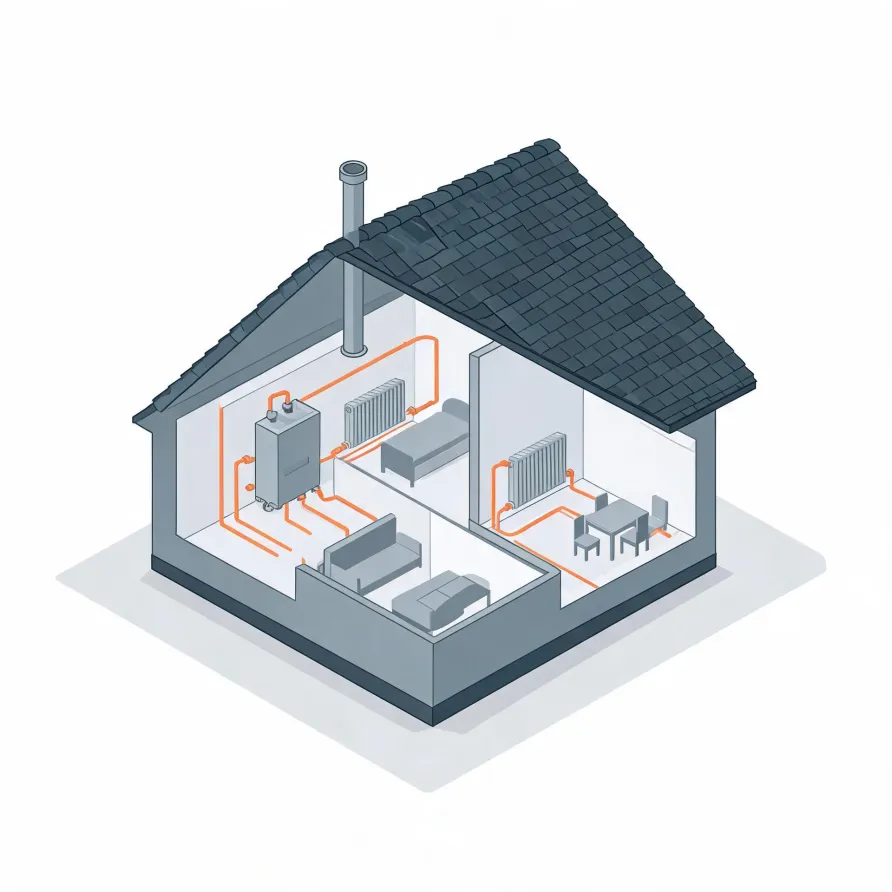
The boiler itself sits in a mechanical room, basement, or utility closet and is the unit a homeowner would notice first. It heats water that the system then sends through the house. A contractor also installs the expansion tank nearby, which absorbs pressure changes in the water as it heats and cools.
Radiators or radiant floor tubing sit throughout the living spaces and are the points where heat actually reaches the rooms. Connecting them to the boiler are supply and return pipes, along with a circulator pump that keeps the heated water moving through the loop. A thermostat, mounted on a wall in the living area, tells the whole system when to run.
The drawing shows a general layout of these components, and a licensed contractor determines what the configuration looks like in your specific home.
Get matched in Santa Cruz CountySanta Cruz County, by the numbers
228 severe weather events were recorded in Santa Cruz County, California between 2015 and 2024.
NOAA National Centers for Environmental Information, Storm Events Database, bulk CSV export, events 2015-01-01 through 2024-12-31.Half the homes in Santa Cruz County, California were built in 1974 or earlier (2020-2024 ACS 5-year).
U.S. Census Bureau, 2020-2024 American Community Survey 5-Year EstimatesSanta Cruz County, California holds 106,977 housing units (2020-2024 ACS 5-year).
U.S. Census Bureau, 2020-2024 American Community Survey 5-Year EstimatesOwners occupy 59.9% of the occupied homes in Santa Cruz County, California (2020-2024 ACS 5-year).
U.S. Census Bureau, 2020-2024 American Community Survey 5-Year EstimatesBoiler Installation Rules for Santa Cruz County, California1 sourced standards and codes
Licensing and Legal Requirements in Santa Cruz County, California
California requires a state contractor license: it is a misdemeanour to engage in the business of, or act in the capacity of, a contractor in California without one, unless the work is exempt.
Weather Events in Santa Cruz County That Stress HVAC Systems
Heating equipment works harder when the weather outside pushes harder, and Santa Cruz County has its own pattern of weather stress that shapes how a boiler is sized, installed, and maintained. What happens in this county is a local load question, not a generic one.
228 severe weather events, 2015–2024. Source: NOAA National Centers for Environmental Information, Storm Events Database.