Tell us about the job
Takes about a minute. No obligation.
A boiler here runs through most of the heating calendar before it ever gets a rest. Homes in Marin County, CA run heat about nine months a year, from October through June. The burner, the heat exchanger, and the ignition system cycle through that load together, and wear on each of them is proportional to what the season actually demanded. When a contractor opens a unit for repair, the heat exchanger is the first place they look hard, because that is where fatigue from sustained cycling shows up first. Scaling, cracking, and seal deterioration all track runtime, and a long heating season compresses how quickly those conditions develop.
Boiler systems in houses this old accumulate layered repair histories: an original cast-iron section, a later copper branch, a mixing valve sourced from a manufacturer that may no longer support it. Half the homes in Marin County, California were built in 1967 or earlier (2020-2024 ACS 5-year). That kind of stock means a contractor pulling a part number from a failed component has to verify whether a current replacement seats correctly against whatever surrounds it, because the surrounding assembly is frequently not original. The answer comes from what the opened system actually shows, not from the model plate.
The Parts of a Boiler a Contractor Checks First
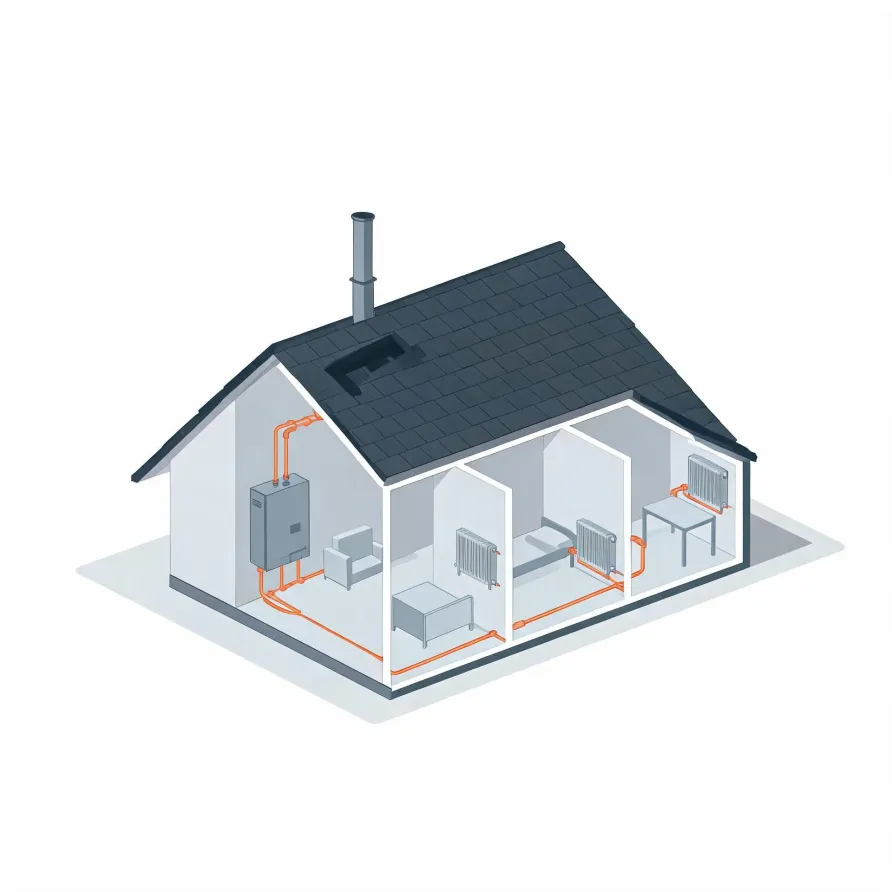
The boiler itself sits in the basement or a utility room and is the piece a contractor goes to first. It heats water and pushes it through the system. When it fails, the signs usually trace back to the heat exchanger, the burner, or the pressure vessel, each of which lives inside that same cabinet.
The circulator pump moves hot water out to the radiators or baseboard units that run through the living spaces. The expansion tank, the pressure relief valve, and the zone valves sit close to the boiler and regulate flow and pressure. Any one of them can be the source of a loss of heat, a pressure fault, or uneven warmth from room to room.
The drawing shows a typical boiler layout, and a licensed contractor determines which components apply to the specific system in your home.
Get matched in Marin CountyMarin County, by the numbers
134 severe weather events were recorded in Marin County, California between 2015 and 2024.
NOAA National Centers for Environmental Information, Storm Events Database, bulk CSV export, events 2015-01-01 through 2024-12-31.Half the homes in Marin County, California were built in 1967 or earlier (2020-2024 ACS 5-year).
U.S. Census Bureau, 2020-2024 American Community Survey 5-Year EstimatesMarin County, California holds 112,116 housing units (2020-2024 ACS 5-year).
U.S. Census Bureau, 2020-2024 American Community Survey 5-Year EstimatesOwners occupy 64.7% of the occupied homes in Marin County, California (2020-2024 ACS 5-year).
U.S. Census Bureau, 2020-2024 American Community Survey 5-Year EstimatesBoiler & HVAC Repair Rules on the Books for Marin County, California1 codes, standards & licensing rules
Licensing and Legal Requirements in Marin County, California
California requires a state contractor license: it is a misdemeanour to engage in the business of, or act in the capacity of, a contractor in California without one, unless the work is exempt.
Weather Events in Marin County That Stress Heating Systems
Boilers work harder when outdoor conditions swing sharply, and that added strain is where wear turns into failure. The chart below tracks recorded severe weather events in this area, because weather history is part of what shapes the repair workload a boiler carries over its life.
134 severe weather events, 2015–2024. Source: NOAA National Centers for Environmental Information, Storm Events Database.